The Lord’s Actual Prayer – Part 2

39862253654_882d5ea141_o
Photo by Michelle Pearson

The Lord’s Actual Prayer – Part 2

This week we are picking up where we left off last week, looking at what Jesus prayed just before going to the cross. So, we’re back in John 17, but starting at verse 12, which says, “During my time here, I protected them by the power of the name you gave me. I guarded them so that not one was lost, except the one headed for destruction, as the Scriptures foretold.” Jesus says here that He has protected those that the Father gave him by the name He gave Him. Remember, the name that the Father gave Jesus was Immanuel, which means, “God with us.” Then He says He saved them all, “except the one headed for destruction, as the Scriptures foretold.” Peter tells us in Acts 1:20, “Peter continued, ‘This was written in the book of Psalms, where it says, ‘Let his home become desolate, with no one living in it.’ It also says, ‘Let someone else take his position.’” This is referring to Psalm 109:8.

There is a lot of talk about predestination. Many believe that God chooses who will be saved and who will not, but the Bible is extremely clear about this. In 2 Peter 3:9 we read, “The Lord isn’t really being slow about his promise, as some people think. No, he is being patient for your sake. He does not want anyone to be destroyed, but wants everyone to repent.” So, God doesn’t choose anyone to not be saved, the choice is ours. And, as far as the question of what the Bible says about predestination, Romans 3:29 tells us where this predestination comes from, “For those whom He foreknew, He also predestined to become conformed to the image of His Son, so that He would be the firstborn among many brethren;” So, we are predestined, because God can see the future and He knows in advance who will accept him. It’s still our choice, but God knows all.

Back to John 17, verses 13-14 say, 13 “Now I am coming to you. I told them many things while I was with them in this world so they would be filled with my joy. 14 I have given them your word. And the world hates them because they do not belong to the world, just as I do not belong to the world.” Jesus tells the Father, “I have given them your word”. Immediately we think He’s talking about the Bible because that’s the word of God, right? What does John say in the first chapter of his book? John 1:1, “In the beginning the Word already existed. The Word was with God, and the Word was God.” Then He goes on in verse 14 to tell us just who that word is, “So the Word became human and made his home among us. He was full of unfailing love and faithfulness. And we have seen his glory, the glory of the Father’s one and only Son.” So, when Jesus tells the Father that He gave us His word, what He is saying is that He gave us Himself…that’s truly awesome, isn’t it? It is the greatest gift of all! He goes on to say that the world hates us because we don’t belong to the world. That is still so true to this day. For some reason, in today’s world of “tolerance”, the only group that it’s okay to say bad things about, is Christians. I mentioned a few weeks ago about the ladies on The View referring to Christianity as “mental illness”. That’s not okay! But, Jesus warned us that they would hate us. In fact, Paul tells us in 2 Timothy 3:12, “Yes, and everyone who wants to live a godly life in Christ Jesus will suffer persecution.” Notice, he doesn’t say that we might, he says that we WILL suffer persecution.

But, here’s the thing, He says in verses 15-16, 15 I’m not asking you to take them out of the world, but to keep them safe from the evil one. 16 They do not belong to this world any more than I do.” You see, leaving the world isn’t the answer. It’s imperative that we stay so that we can bring the world to Christ, but we must remember that we are not part of this world. Romans 12:2 tells us, “Don’t copy the behavior and customs of this world, but let God transform you into a new person by changing the way you think. Then you will learn to know God’s will for you, which is good and pleasing and perfect.” We must be in the world, but we can’t be of the world.

In verse 17 He says, “Make them holy by your truth; teach them your word, which is truth.” So many times, I have heard Christians say that they can’t be holy, only God is holy, and yet in this verse, Jesus is praying that we will be holy. Here’s the thing, the word holy means “to be set apart”. As Christ followers, we are to be set apart, and that’s what Romans 12:2 is getting at. We must be transformed, we must change the way we think, we must be set apart. In fact, 1 Peter 1:16 says, “For the Scriptures say, ‘You must be holy because I am holy.’” Here, Peter is referencing Leviticus 11:44-45, 19:2, and 20:7. So, don’t let anyone tell you that you can’t be holy…the truth is, you must be holy! And, how do we accomplish that? As we see in verse 17, by His truth. And, where does that truth come from? As it also says, “teach them your word, which is truth.” We also see this in Psalm 119:160, “The very essence of your words is truth; all your just regulations will stand forever”

Verses 18-19 tell us, 18 Just as you sent me into the world, I am sending them into the world. 19 And I give myself as a holy sacrifice for them so they can be made holy by your truth.” He is sending us into the world, and He has made us holy by God’s truth, through His sacrifice.

I love verse 20, “I am praying not only for these disciples but also for all who will ever believe in me through their message.” This prayer is for me! This prayer is for you! This prayer is as much for us as it was for His disciples back then.

And, what is this prayer? Verse 21 says again, “I pray that they will all be one, just as you and I are one—as you are in me, Father, and I am in you. And may they be in us so that the world will believe you sent me.” There are four more verses to this prayer, but I’m going to end here, you can go study the other four yourself. I want to end on this note because this is so important. I have said over and over throughout my blogs that one of the key themes of the New Testament is that of the unity of believers. Christ’s prayer really drives that home, because, in the twenty-five verses of this prayer, two of them are praying that we would be united. That’s 8% of this prayer. Of all the things He could have prayed for, and all the things He did pray for, He prayed for our unity twice!

I’ve said it before, but it’s worth repeating. If we want to impact our world for Christ, we must be united. We must put aside our petty differences and unite around the shed blood of Jesus Christ. The only doctrine that matters is that of salvation by God’s grace, through our life-changing faith in the death, burial, and resurrection of Jesus Christ. PRAY FOR UNITY!

The Lord’s Actual Prayer – Part 1

39862253654_882d5ea141_o
Photo by Michelle Pearson

The Lord’s Actual Prayer

Okay, so this one will be a two-part series. We’ll start today and finish it next week. We all grew up memorizing “The Lord’s Prayer”, “Our Father who art in heaven, hallowed be thy name…” I’m sure that you can finish it. Somewhere along the line, we mislabeled this, because Jesus never prayed this prayer. In fact, He never told us to repeat it in unison or say it every time we gather. The truth is that He never told us to say it at all. That passage we call “The Lord’s Prayer” was nothing more than an outline that He gave us. The disciples had asked Him how to pray, and He said in Matthew 6:9, “Pray like this…”, or in the KJV it says “in this manner…”. So, it was just an outline, He was saying to start out by praising God, then pray for His kingdom to come, and so on.

But, this isn’t a blog on Christ’s outline for prayer, this is a blog on what the Lord actually prayed. With Easter weekend rapidly approaching, I wanted to look at the prayer that Jesus prayed just before He was betrayed and arrested. We find this prayer in John chapter 17. He starts out the prayer, in the first 2 verses by saying, “After saying all these things, Jesus looked up to heaven and said, ‘Father, the hour has come. Glorify your Son so he can give glory back to you. For you have given him authority over everyone. He gives eternal life to each one you have given him.’” Notice He says that He has given eternal life to everyone that the Father has given Him. The phrase “have given”, in the Greek language, is a perfect indicative tense, which means that it is an action that was completed in the past but has continuing results, and the indicative mood is an assertion of fact. So, in those two little words, Christ is saying that it is a fact that the Father has given and continues to give Him souls to save. Wow, God is good!

Verse 3 very simply tells us how we can be saved, “And this is the way to have eternal life—to know you, the only true God, and Jesus Christ, the one you sent to earth.” To know the one true God and Jesus, the Christ. The word He used here translated “to know”, is the Greek word ginosko. This word indicates an intimate knowledge, in fact, it is also used as an idiom for sexual intercourse between a man and woman. You see, just a head knowledge of God will never suffice, let’s face it, the devil has that. He wants us to have an intimate knowledge of Him. He wants us to be consumed by Him. When you are in love, that person is the only thing you think about, and that’s the relationship He requires from us.

In verses 4 and 5 He says, I brought glory to you here on earth by completing the work you gave me to do. Now, Father, bring me into the glory we shared before the world began.” So, Jesus knows that He is about to complete His work here on earth and that this has brought glory to the Father. But, did you notice what He said in verse 5? “Bring me into the glory we shared before the world began.” If anyone tries to tell you that Jesus never said He was God, you can show them this verse, and there are several others, but that is another blog.

In verses 6-8 He talks about the work that He completed here on earth when He says, “I have revealed you to the ones you gave me from this world. They were always yours. You gave them to me, and they have kept your word. Now they know that everything I have is a gift from you, for I have passed on to them the message you gave me. They accepted it and know that I came from you, and they believe you sent me.” Jesus came to reveal the Father to the world. We were always God’s, but Christ opened a pathway directly to the Father, through Himself.

In verse 9 Jesus says, “My prayer is not for the world, but for those you have given me because they belong to you.” When He says that His prayer is not for the world, it is not saying that He doesn’t care about the world’s plight, 2 Peter 3:9 tells us, “The Lord isn’t really being slow about his promise, as some people think. No, he is being patient for your sake. He does not want anyone to be destroyed, but wants everyone to repent.” He said this because His focus, at that time, was on His disciples. Not just the twelve, but all of us. I like the way Campbell Morgan put it when he said, “He was praying for the instrument He was creating, through which He would reach the world.”

Christ states in verse 10 that, “All who are mine belong to you, and you have given them to me, so they bring me glory.” Again, we are created for His glory, that is our purpose.

Verse 11 is where Jesus really starts praying for us, he says, “Now I am departing from the world; they are staying in this world, but I am coming to you. Holy Father, you have given me your name; now protect them by the power of your name so that they will be united just as we are.” Christ is praying for us because He is leaving us and going to the Father. I can relate to this. In 2009 Michelle and I had to leave Los Angeles and go to Florida to help my mother. This trip was supposed to be for two months, but it soon became apparent that it was going to be more permanent. At this time, although they were still living with us, our sons were adults, Josh was twenty-three and Caleb was nineteen. But, that didn’t stop us from worrying about them and praying for them daily. Those prayers helped them through that time, which is too lengthy of a story to get into now, but God did bring us all back together six years later. We are all in Los Angeles but now they are both married, and we have six grandkids…God is good! But, what did Christ pray over us? He asked the Father to protect us by the power of His name, and why? So that we will be UNITED, as they are.

If you have been reading my blogs for any length of time, you have seen that I talk a lot about the unity of the body of Christ. The reason I talk about it so much is because this is one of the key themes of the New Testament, and sadly, the body is more divided than ever. We are divided into different denominations, and into different groups within those denominations. And, worst of all, largely we are divided over doctrine that was taken out of context, to begin with, and mostly doesn’t matter. What matters is salvation by grace, through faith in the shed blood of Jesus Christ…that’s it. If we ever want the Church to impact our world again, we must be united! We keep blaming everyone else for the state the world is in, whether it be the media, or Muslims, or liberals, but the fact is that IT IS OUR FAULT! Christ told us that a house divided will fall, and we have fallen. But, there is good news, it’s not too late. 2 Chronicles 7:14 tells us that if believers, that’s all of us, will humble ourselves, and pray if we will seek His face and turn from our wicked and divisive ways, He will hear our prayers, forgive our sin, and heal our land. Let’s come together as the body of Christ.

This is only half of this prayer, there is so much more to see, so I will be finishing it next week. Until then, pray for unity and that God will open our eyes to His will.

The Law

Old Courthouse Museum
Photo by Michelle Pearson

The Law

I’m afraid the Church is confusing many unsaved people, as well as many new Christians, and even many older Christians for that matter. I hear it over and over, they say, “you say the Bible never changes. Then why were the people in the Old Testament saved by keeping the law, but you say that we’re saved by grace through faith now?” I’m sure we’ve all heard this question. But, here’s the problem. They are confused because many of our churches, many well-intentioned pastors, are unknowingly preaching a false doctrine. Please don’t stop reading here and think that I’m one of those guys that think I’ve figured it out and everyone else is wrong. I just want to share what scripture says, and you can make your own decision, but remember to keep everything in context, and don’t try to interpret the Bible.

So, did the law ever save anyone? Romans 8:3 tells us, “The law of Moses was unable to save us because of the weakness of our sinful nature. So, God did what the law could not do. He sent his own Son in a body like the bodies we sinners have. And in that body God declared an end to sin’s control over us by giving his Son as a sacrifice for our sins.” The campus pastor at our church, Steve Meharg, would say right now, “don’t you hate how the Bible is so vague?” So, what is the Bible saying here? The first sentence of this verse tells us that the law of Moses was not able to save us. Why? Because of our sinful nature. You see, we can’t be good enough to get to heaven, because of our sinful nature.

Here’s wherein the problem lies. We are sinners! Romans 5:12, “When Adam sinned, sin entered the world. Adam’s sin brought death, so death spread to everyone, for everyone sinned.” Again, so unclear, right? When we try to be good enough to get to heaven, we are measuring ourselves up to other people, and we can always find someone who is worse than ourselves. A serial killer can say that he’s not as bad as Jeffery Dahmer because he isn’t a cannibal. But, here’s the catch, God doesn’t measure us up to each other, He measures us up to Himself. Galatians 5:19-21 says, 19 When you follow the desires of your sinful nature, the results are very clear: sexual immorality, impurity, lustful pleasures, 20 idolatry, sorcery, hostility, quarreling, jealousy, outbursts of anger, selfish ambition, dissension, division, 21 envy, drunkenness, wild parties, and other sins like these. Let me tell you again, as I have before, that anyone living that sort of life will not inherit the Kingdom of God.” Do you see that…no sin can enter heaven…none! Notice that, along with idolatry and sexual sin, He also adds quarreling and jealousy…any one sin will keep you out of heaven. We also read in Ephesians 2:8-9, God saved you by his grace when you believed. And you can’t take credit for this; it is a gift from God. Salvation is not a reward for the good things we have done, so none of us can boast about it.” Again, he says that we are not saved by our works, not now, not ever!

We also know that they weren’t saved by just being born into one of the tribes of Israel, although they tried to make it about that too. Look at the examples of Rahab and Ruth. Rahab was a prostitute and a Canaanite, and Ruth was a Moabite. Not only did Rahab not keep the law of Moses, she wasn’t born an Israelite…that’s a double whammy. And, Ruth was not an Israelite either, she was a Moabite. But, not only did God save them, He went a step further. God did something He didn’t have to do by making Rahab and Ruth part of the lineage of Christ. We see this in the first chapter of Matthew. The first sixteen verses are giving the lineage of Christ, from Abraham to Joseph, and in verse 5 it says, “Salmon was the father of Boaz (whose mother was Rahab). Boaz was the father of Obed (whose mother was Ruth).” There are very few mothers mentioned in this passage, but he names two in this verse alone, Rahab and Ruth. Both of these women are in the lineage of Christ, and neither are Israelites.

So, if the Old Testament believers weren’t saved by keeping the law, and they clearly weren’t saved by being born a Jew, then how exactly were they saved? Yes, it is true that they did have to offer sacrifices every year because the perfect sacrifice had not yet come. But it wasn’t the sacrifice that saved them, it was their faith. Let’s take a minute to look at Hebrews chapter 11, the chapter known as the Believer’s Hall of Faith. I’m not going to print the entire chapter here, but take a minute to read it, even if you have read it many times, then come back.

Did you notice something about it? Let’s take a look at the people mentioned here: verse 4, Able; verse 5, Enoch; verse 7, Noah; verses 8-10, Abraham, Isaac, and Jacob; verse 11 Sarah; verse 21, Jacob; verse 22, Joseph; verse 23, Moses; verse 31, Rahab; verse 32, Gideon, Barak, Samson, Jephthah, David, Samuel, the prophets. Everyone mentioned in this passage is from the Old Testament. They were not made righteous by keeping the law, they were made righteous by their life-changing faith! In the middle of all this it says in Hebrews 11:6, “And it is impossible to please God without faith. Anyone who wants to come to him must believe that God exists and that he rewards those who sincerely seek him.” It is, and always was, IMPOSSIBLE to please God without FAITH!

But, something we must remember because we humans always try to make it about ourselves, is that it’s not our faith that saves us. God saves us when He sees our faith. And, faith doesn’t just mean believing. The Bible tells us in James 2:19, “You say you have faith, for you believe that there is one God. Good for you! Even the demons believe this, and they tremble in terror.” So, you see, it’s not just about believing, it’s about trusting and changing. Just before this verse, we see in James 2:14-17, 14 What good is it, dear brothers and sisters, if you say you have faith but don’t show it by your actions? Can that kind of faith save anyone?15 Suppose you see a brother or sister who has no food or clothing,16 and you say, “Good-bye and have a good day; stay warm and eat well”—but then you don’t give that person any food or clothing. What good does that do? 17 So you see, faith by itself isn’t enough. Unless it produces good deeds, it is dead and useless.”

We are now, and always have been saved by God’s grace, through our faith…our life-changing faith. So, let’s stop confusing people and start living by faith.

One More Church – Philadelphia

34389605650_e27dae43bb_o
Photo by Michelle Pearson

One More Church – Philadelphia

In this letter in Revelation 3:7-13, Christ is writing to the Church in Philadelphia. And, though He isn’t writing to the Church in Philadelphia, PA…He is. These letters weren’t just to the churches they were addressed to, they were written to us all…the Church. As we all know, Philadelphia means “brotherly love” and this Philadelphia was set up as a missionary outpost for Hellenism. Its purpose was to spread the Greek language and culture across Asia. Philadelphia was called “Little Athens” and was a prosperous city known for beautiful buildings, and earthquakes…reminds me of LA.

In this letter, Christ introduces Himself in verse 7 this way, “This is the message from the one who is holy and true, the one who has the key of David. What he opens, no one can close; and what he closes, no one can open:” Notice, He first introduces Himself as “the one who is holy and true.” He is holy, which means that He is set apart, but he is also true…He is truth in physical form. After this, when He says, “the one who has the key of David”, He is referring to Isaiah 22:22 where it says, “I will give him the key to the house of David—the highest position in the royal court. When he opens doors, no one will be able to close them; when he closes doors, no one will be able to open them.” So, in this passage, Christ is showing that Eliakim, talked about in Isaiah 22 as well as 1 Kings 18 and Isaiah 36, was a prophecy of Christ.

He starts out verse 8 by saying, “I know all the things you do, and I have opened a door for you that no one can close.” Again, He says he knows all the things they do, but this time He tells them that He has opened a door for them that no one can close. This is one of those things that we have made somewhat cliché. We’ve all seen the mems that say, “If God closes a door, He’ll open a window.” The truth is that if God closes a door, no one can open it. Yes, He always has a purpose for our lives, and He will open another door somewhere else. Please don’t get me wrong, I’m not trying to bash Christian mems, or say they are wrong in any way. The problem is when they become cliché and lose their meaning.

He finishes verse 8 by saying, “You have little strength, yet you obeyed my word and did not deny me.” This is a beautiful thing. He says that they had little strength. You see, they didn’t trust in their own strength, they just trusted in God. We can all learn from the church at Philadelphia. So often we think we are strong, so we don’t rely on God. We believe we can handle it, so we trust in our own strength. Here’s a news flash, our own strength will always fail us. This church trusted in God’s strength, so they were strong.

In verse 9 He says, “Look, I will force those who belong to Satan’s synagogue—those liars who say they are Jews but are not—to come and bow down at your feet. They will acknowledge that you are the ones I love.” It appears that this church was being persecuted by the people of the Jewish synagogue. In fact, Jesus calls them “Satan’s synagogue” and says they claim to be Jews, but they are not. Then He reassures the church that these people will one day bow down at their feet and admit that they are the ones that Christ loves.

There are a lot of churches out there that claim the name of Christ but are really Satan’s synagogue, and some of them might surprise you. You see, this synagogue in Revelation was persecuting Christ’s Church because the church at Philadelphia didn’t believe what they believed. They were trying to undermine what this Church was doing because they didn’t believe it was right. But, what did Jesus say? One day, these people would bow down at their feet and admit that this Church is the ones that Christ loves. As I’ve mentioned before, most of the things that divide us are the doctrines that aren’t even scriptural. Believe me, I’ve been on the judging end of this before, until Christ got ahold of me and showed me where I was wrong.

In verses 10-12a, Jesus tells them, 10 “Because you have obeyed my command to persevere, I will protect you from the great time of testing that will come upon the whole world to test those who belong to this world. 11 I am coming soon. Hold on to what you have, so that no one will take away your crown. 12 All who are victorious will become pillars in the Temple of my God, and they will never have to leave it.” Again, He is letting them know what will happen if they are victorious. He says that because they have persevered, He will protect them from the great tribulation, and He clarifies that this great tribulation is a test for those who belong to the world, and clearly this church did not. He goes on to ensure us that He is coming soon. I know that many people say, “but, He said this two thousand years ago,” but we must remember that time is not the same to Jesus. 2 Peter 3:8, “But you must not forget this one thing, dear friends: A day is like a thousand years to the Lord, and a thousand years is like a day.” So, when He says that He is coming soon, what He is really saying is that we need to be ready because it could be today. Matthew 24:36, “However, no one knows the day or hour when these things will happen, not even the angels in heaven or the Son himself. Only the Father knows.”

After He tells them that He is coming soon, He says to be careful that no one takes away your crown. So, what crown is He talking about? There are five crowns talked about in the Bible that we can receive in Heaven:

  • The Crown of Righteousness 2 Timothy 4:8
  • The Crown of Victory 1 Corinthians 9:25-27
  • The Crown of Life James 1:12; Revelation 2:10
  • The Crown of Glory 1 Peter 5:2-4; Matthew 5:19
  • The Crown of Rejoicing 1 Thessalonians 2:19; Daniel 12:3; Proverbs 11:30

He ends verse 12 by telling them that everyone who is victorious will become pillars in God’s temple, meaning they will become permanent fixtures, they will be secure.

Christ ends this letter, in verse 13, the same way He ended all the other letters, by telling them, “Anyone with ears to hear must listen to the Spirit and understand what he is saying to the churches.” Again, He wants us to listen to this warning. He wants us to hear it and examine our own lives. We need to look at the Church at Philadelphia as an example. We can’t trust in our own strength, and we must be victorious!

More Churches – Thyatira

34389605650_e27dae43bb_o
Photo by Michelle Pearson

More Churches – Thyatira

Thyatira was an interesting choice for Jesus to send a letter to in the Revelation. You see, Thyatira was a very insignificant city, in fact, according to Barclay, “The elder Pliny dismissed Thyatira with the almost contemptuous phrase ‘Thyatira and other unimportant cities.’” The only thing Thyatira had going for it was its trade guilds, it had more trade guilds than any two cities of its size, and it was known for making purple dye and purple fabric…the fabric of royalty.

This time, when Christ describes Himself, He comes right out and says, “This is the message from the Son of God” in Revelation 2:18. Then He goes on to describe Himself even further when he says, “whose eyes are like flames of fire, whose feet are like polished bronze.” Again, He takes this from John’s description of Him in Revelation 1:14-15. So, what did He mean by eyes like flames? Fire often represents the Holy Spirit, as we see in Acts 2:2-4, another sign pointing to the triune nature of God. Fire can also represent refinement, as with metals, or judgment. The feet like polished bronze is referring to His steadfastness. Bronze was the hardest metal known at that time and the bronze feet represent that Christ is immovable. So, this description of Him is demonstrating His steadfast, immovable judgment on the people.

He goes on in verse 19 to say, “I know all the things you do. I have seen your love, your faith, your service, and your patient endurance. And I can see your constant improvement in all these things.” So, as with the church at Ephesus, He starts out by complimenting them on what they are doing right. But, notice that He begins by saying, “I know all the things you do.” He’s about to compliment them, but lets them know up front that He knows it all…the good, the bad, and the ugly. Then He goes on to talk about their love, their faith, their service, and their patience. Do you recognize these? You should, because they are some of the fruits of the Spirit seen in Galatians 5:22-23, 22 But the Holy Spirit produces this kind of fruit in our lives: love, joy, peace, patience, kindness, goodness, faithfulness, 23 gentleness, and self-control. There is no law against these things!”

It’s looking pretty good for the church at Thyatira, but then He hits them with, “But I have this complaint against you. You are permitting that woman—that Jezebel who calls herself a prophet—to lead my servants astray. She teaches them to commit sexual sin and to eat food offered to idols”, in verse 20. So, there was a woman in the church leading them astray. She was obviously a woman of authority, some believe she could have been the pastor’s wife, but she was a self-proclaimed prophet. Now, this is where many churches are divided, and is where we need to take the Bible literally and in context. The Bible never says that a woman can’t be a prophet. In fact, if you look at the accounts of the birth of Christ, it talks about Anna who was a prophet, and there were many other examples. But, the problem here is that they didn’t do what they were taught. John says in 1 John 4:1, “Dear friends, do not believe everyone who claims to speak by the Spirit. You must test them to see if the spirit they have comes from God. For there are many false prophets in the world.” So, the problem wasn’t that she was a woman, the problem was that she was a false prophet and the church didn’t test what she said against scripture, they just believed her. Jesus goes on to call her Jezebel. It is possible that her name was actually Jezebel, but it is more likely that Christ is using that name to describe what she was. So, let’s think about who Jezebel was in the Old Testament. She was found in 1 Kings 16-21, and in 2 Kings 9:30-37, and she was one of the evilest people mentioned in the Old Testament. She was the wife of King Ahab and tried to use her place of power to combine Israel’s worship with the worship of Baal, which included sexual sin and pagan practices.

In verse 21 Christ says, “I gave her time to repent, but she does not want to turn away from her immorality.” Even this horrible, evil woman who was trying to lead the Christ followers astray, Christ gave time to repent. You see that? He didn’t just give her a chance, He gave her time, but she wouldn’t turn from her immorality.

In verses 22 and 23, Jesus tells them what He will do to her, and them, if they don’t repent and turn from their evil ways, He says, 22Therefore, I will throw her on a bed of suffering, and those who commit adultery with her will suffer greatly unless they repent and turn away from her evil deeds. 23 I will strike her children dead. Then all the churches will know that I am the one who searches out the thoughts and intentions of every person. And I will give to each of you whatever you deserve.” There are those who say that a loving God wouldn’t punish us. The problems with that school of thought are that, as we just saw, He always gives us a choice. He won’t make us do right, He wants us to choose Him, to choose to do right. And, secondly, He is a loving Father, and a truly loving father will discipline his children. First, to try to correct them and turn them back to the right path, and second to demonstrate to His other children that there are consequences to doing wrong, Proverbs 13:24.

He goes on, in verses 24 through 27, commending those who are victorious, and tells them that He will give them the authority to rule nations. Then in verse 28 He repeats that promise and tells them that He will give them the same authority His Father gave to Him. He ends verse 28 by saying, “and I will also give them the morning star!” So, what does He mean by this? If we look at the end of the book of the Revelation, we see in Revelation 22:16, “I, Jesus, have sent my angel to give you this message for the churches. I am both the source of David and the heir to his throne. I am the bright morning star.” This is truly awesome! What Jesus is saying here is that if we are victorious, He will give us the greatest gift of all…He will give us Himself!

Of course, like in all the other letters, Christ ended this one in verse 29 by saying, “Anyone with ears to hear must listen to the Spirit and understand what he is saying to the churches.” He wants us to hear the warning to this church, and He wants us to be victorious and claim the ultimate prize…Him!

More Churches – Pergamum

34389605650_e27dae43bb_o
Photo by Michelle Pearson

More Churches – Pergamum

I love how, in each of these seven letters, Christ gives His credentials in a different way. He tailors His introductions to His audience. In His letter to the Church at Pergamum, in Revelation 2:12-17, He introduces Himself this way: verse 12, “This is the message from the one with the sharp two-edged sword:” Here, He is referring to John’s description of Him in Revelation 1:12-16, where in verse 16 he says, “He held seven stars in his right hand, and a sharp two-edged sword came from his mouth. And his face was like the sun in all its brilliance.” And, Hebrews 4:12 tells us, “For the word of God is alive and powerful. It is sharper than the sharpest two-edged sword, cutting between soul and spirit, between joint and marrow. It exposes our innermost thoughts and desires.” So, this two-edged sword that comes out of His mouth will expose our innermost thoughts and desires.

And, what does He say next? Revelation 2:13, “I know that you live in the city where Satan has his throne, yet you have remained loyal to me. You refused to deny me even when Antipas, my faithful witness, was martyred among you there in Satan’s city.” So, why does Jesus call Pergamum the city where Satan has his throne? There were several temples to many Greek and Roman gods in Pergamum, but the main one was the temple of Zeus, the king of the Greek gods. And, in that temple was the throne of Zeus, which is believed to be what Christ is referring to in this book. Pergamum was a very wicked city, full of pagan gods and rituals. He also mentions Antipas in this verse. Antipas was faithful to Christ and the leader of the Christian church there. He was being so effective for Christ there, casting out demons and leading people to a relationship with Christ that the pagan priests went to the Rome governor to complain that Antipas’ prayers were driving their spirits out of the city and hindering the worship of their gods. He was martyred by being roasted alive in a bronze bull. This is the type of city these believers were in.

Verse 14 starts out by saying, “But I have a few complaints against you.” Even though they were enduring all of this, Christ still had to set them straight in a few areas. He goes on to say, “You tolerate some among you whose teaching is like that of Balaam, who showed Balak how to trip up the people of Israel. He taught them to sin by eating food offered to idols and by committing sexual sin.” Do you remember the story of Balaam? You know, the guy whose donkey had to set him straight. Balaam tried to sell his gift of prophecy for financial gain, but when he realized that he couldn’t prophesy against God’s people, he helped Balak by selling out Israel. He told Balak that all he had to do to weaken Israel was to seduce the men into sexual sin and pagan rituals. This brought the judgment of God on the men who participated. 2 Peter 2:15 talks about Balaam when he says, “They have wandered off the right road and followed the footsteps of Balaam son of Beor, who loved to earn money by doing wrong.” So, Peter is saying that the way of Balaam is to choose to do wrong for personal gain. We also hear about Balaam in the book of Jude verse 11 where he says, “What sorrow awaits them! For they follow in the footsteps of Cain, who killed his brother. Like Balaam, they deceive people for money. And like Korah, they perish in their rebellion.” Jude’s account of Balaam is that he deceived people for money. So, the first thing Christ has against the church at Pergamum is that some of them were following in the footsteps of Balaam.

The next thing He says in verse 15 is, “In a similar way, you have some Nicolaitans among you who follow the same teaching.” Remember in Christ’s letter to the church at Ephesus, in Revelation 2:6, He said, “But this is in your favor: You hate the evil deeds of the Nicolaitans, just as I do.” So, He praised the church at Ephesus for hating the deeds of the Nicolaitans and warned the church at Pergamum about some of them who were following their deeds. I know you are probably wondering what these Nicolaitans were doing. David Guzik says this about the Nicolaitans, “The title Nico-laitans has the idea of a proud authority and a hierarchical separatism. The name Nikao-laos literally means “to conquer the people.” According to ancient commentators, the Nicolaitans also approved of immorality.” So, these were immoral people trying to conquer everyone around them. But here’s the thing, God wasn’t just condemning the ones who were following the teachings of Balaam and the Nicolaitans, He was condemning the ones who were allowing it to go on among their church.

So, what does Christ tell them to do? In verse 16 He says, “Repent of your sin, or I will come to you suddenly and fight against them with the sword of my mouth.” He tells them that they must repent. The word repent literally means to turn around, go the other direction, do a 180. He is telling them to turn away from those beliefs, and from allowing those beliefs in their church, and turn back to Him. If they don’t do this, He says that He will fight against them with the sword of His mouth. As we saw at the beginning of this passage, that sword is the word of God, and it cuts to the joints and marrow and exposes their innermost thoughts and desires. So, if they don’t repent, God will strike them down with His word.

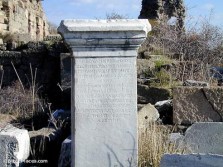
He ends in verse 17, as with all the others, by telling them, “Anyone with ears to hear must listen to the Spirit and understand what he is saying to the churches.” But, He goes further with this one. He goes on to say, “To everyone who is victorious I will give some of the manna that has been hidden away in heaven. And I will give to each one a white stone, and on the stone, will be engraved a new name that no one understands except the one who receives it.” He’s not just telling them what he will do if they don’t repent, He also tells them what He will do if they do repent. He will give them some of the manna that is hidden in heaven. So, He won’t just feed them, He’ll give them the best. Then He goes on to tell thPergamum-inscription-on-white-stone-tb010901781-bibleplacesem about these white stones.  We’re not sure what the white stones were for, but the people of Pergamum knew what Christ was talking about. Throughout the ruins of ancient Pergamum there are white stones with names inscribed on them, so they understood whatever significance they had. But, look at what He says. He tells them that he will engrave a new name on the stone that’s just between you and God. It demonstrated the intimate relationship that Christ wants to have with us.

I love how, in the end of this passage, after Christ has warned the church about following these false doctrines, after He has told them what He will do if they don’t obey, He tells them that, if they repent, he will forgive them and restore that intimate relationship that He wants to have with us. Isn’t it awesome to have a God that is so forgiving? But, never forget that He loves us so much that He will punish us if we are doing wrong, so let’s live to please the one we love…the one who first loved us.

More Churches – Smyrna

34389605650_e27dae43bb_o
Photo by Michelle Pearson

More Churches – Smyrna

I realize I said we were only going to look at two of these churches, but there is so much here, I believe we need to look at more of them.

In Revelation 2:8-11, Jesus is talking to the Church at Smyrna. We know that it is Christ who is talking, because He starts out in verse 8 by saying, “And to the angel of the church in Smyrna write: The first and the last, who was dead, and has come to life, says this:” Notice that all of these warnings are written to the angel of the church. The word angel means messenger, envoy, one who is sent, a messenger from God. So, what He is saying is that He is giving this letter to the messenger for that church at Smyrna. Then He goes on with His credentials. He says, “The first and the last, who was dead, and has come to life, says this:” So, who is writing this? The Alpha and the Omega, the beginning and the end, the first and the last…I have had some say that this must be talking about Jehovah, God the Father, because He is the first and the last, but you must finish the verse. He goes on to say, “who was dead, and has come to life.” That can only be talking about Jesus! The fact that He begins by saying that He is the first and the last only confirms the Trinity, they are one and the same.

The next thing He says, in verse 9 is, “I know about your suffering and your poverty—but you are rich!” Think back to the church at Laodicea in chapter 3, verse 17 where He told them, “You say, ‘I am rich. I have everything I want. I don’t need a thing!’ And you don’t realize that you are wretched and miserable and poor and blind and naked.” Do you see the contrast? The church at Laodicea thought they were rich, monetarily, but they were spiritually destitute. On the other hand, the church at Smyrna is poor monetarily, but He says they are truly rich spiritually. We get so caught up in the things of this world that we often forget what we are here for. Don’t let anyone tell you that you will be wealthy if you are in God’s will, that is simply unscriptural. I’ve had people give me reasons why they think Christ was wealthy, but if He was wealthy, why did He not have a home? Jesus said Himself in Luke 9:58, “But Jesus replied, “Foxes have dens to live in, and birds have nests, but the Son of Man has no place even to lay his head.” Also, if Christ and His disciples were wealthy, then why did He have to perform a miracle, in order to pay their taxes? We see this in Matthew 17:27, “However, we don’t want to offend them, so go down to the lake and throw in a line. Open the mouth of the first fish you catch, and you will find a large silver coin. Take it and pay the tax for both of us.” So, Christ and His disciples weren’t wealthy as this world sees wealth because that stuff didn’t matter to them.

Jesus goes on at the end of verse 9 saying, “I know the blasphemy of those opposing you. They say they are Jews, but they are not, because their synagogue belongs to Satan.” You see, there are a lot of people and churches and pastors out there that don’t preach the truth. Christ said that He knows who they are and that they are really serving Satan. This is why it is so important to study the Bible literally and in context, and never try to put our own interpretation on it. These people who were opposing the church at Smyrna thought they were serving God, because of the way they had interpreted the scripture, but Christ said that they were serving Satan.

He starts out verse 10 by saying, “Don’t be afraid of what you are about to suffer.” I love that He had to tell them that. So often we look at people who have suffered or even been martyred for Christ as somewhat superhuman. But, they are just like you and me. They are afraid of the unknown just like we are. So, Christ needed to tell them not to be afraid. He goes on in verse 10 to say, “The devil will throw some of you into prison to test you. You will suffer for ten days.” Okay, He tells us not to be afraid, but it’s going to be bad, and He even says that some of them will be thrown into prison, but then He limits it. He says that He will let Satan persecute them, but only for a little while as a test. I love that when Christ allows us to be tested, He gives us the answers to the test first. In fact, He even tells us the reward for passing the test up front. At the end of verse 10 He says, “But if you remain faithful even when facing death, I will give you the crown of life.” So, we will be persecuted, we may even face death, but if we remain faithful, He will give us a crown of life. In the Greek language, there are two words for crown. One of those words means a crown, like a king would wear, but the other word, stephanos, which is the one used here, means a victor’s crown. Winners of athletic events and even the original Olympics would be presented with a crown, a stephanos. Christ is saying that if we endure, we will be given a trophy, a reward, for our perseverance, and that reward is life…eternal life. But, here’s the thing, we can all endure, we can all be the victor because we have the secret weapon…Jesus. Christ told us in John 16:33, “I have told you all this so that you may have peace in me. Here on earth you will have many trials and sorrows. But take heart, because I have overcome the world.” You see, we truly have nothing to fear! Yes, we will face trials, and we will face sorrows, but we will never face them alone! We can take heart…because Christ has already overcome the world! It doesn’t get any better than that!

Two Bad Examples – The Second

34389605650_e27dae43bb_o
Photo by Michelle Pearson

Two Bad Examples – The Second

Last time we looked at the first example from Revelation chapter 2. This time I would like to take a look at another, the church at Laodicea which is talked about in chapter 3, verses 14-22. He starts out in verse 14 by saying, “This is the message from the one who is the Amen—the faithful and true witness, the beginning of God’s new creation.” Notice it says that the message is “from the one who is the Amen”. The word “Amen”, has several meanings, but they are all related. For instance, when your pastor is preaching, and someone says “Amen”, they are saying “Surely, truly, of a truth”. When you end your prayer by saying, “in Jesus name, amen”, you are saying, “so it is, so be it, may it be fulfilled”. But, in this case, where it is referring to a person, it is a metaphor for faithful. So, what this is saying is, “This is the message from the one who is the faithful one.” And, we all know there is only one truly faithful one…Jesus.

Now, once He is finished identifying Himself, He get’s right into it. He doesn’t sugar coat anything, He doesn’t even make a compliment sandwich this time. He simply says in verse 15, “I know all the things you do, that you are neither hot nor cold. I wish that you were one or the other!” If you remember, when He spoke to the church at Ephesus, he started out by talking about all the good things they were doing, but not with this one. From the looks of it, they weren’t doing anything right. Notice what He says here. The problem He had with them is that they were not hot nor cold. So, in our human thinking, not being cold should be a good thing, right? But what does verse 16 say? “But since you are like lukewarm water, neither hot nor cold, I will spit you out of my mouth!” Okay, so because they were lukewarm, or tepid, it says He wants to spit them out of His mouth. Some translations say spew them out, but the Greek word used here is emeo, which means “to vomit, vomit forth, throw up”. So, what God is telling the church at Laodicea is, “you make me want to puke!”

He goes on to say in verse 17, “You say, ‘I am rich. I have everything I want. I don’t need a thing!’ And you don’t realize that you are wretched and miserable and poor and blind and naked.” I think we all know this person. They are wealthy, so they are very condescending and think that people without a lot of money are not as wise as them. They think that because they have all this money and have traveled the world, that they have a handle on life. But, the truth is, that these people are often lonely. Don’t get me wrong, they probably have a lot of “friends”, but no one who is loyal and trustworthy. They are empty inside. These people are miserable, they are wretched, they are poor, blind and naked, and they don’t even realize it.

Jesus tells us in verse 18 how to remedy those problems, He says, “So I advise you to buy gold from me—gold that has been purified by fire. Then you will be rich. Also buy white garments from me so you will not be shamed by your nakedness, and ointment for your eyes so you will be able to see.” You see, we could have all the money of Bill Gates, but we would still be empty spiritually. The Bible tells us in Mark 8:36-37, 36 And what do you benefit if you gain the whole world but lose your own soul? 37 Is anything worth more than your soul?” The answer is, nothing!  Watch this video by Francis Chan that describes our life here on earth as compared to eternity (insert video). Mark 8:38 goes on to say, “If anyone is ashamed of me and my message in these adulterous and sinful days, the Son of Man will be ashamed of that person when he returns in the glory of his Father with the holy angels.” So many people today want to believe that any religion is good when the truth is that NO religion is good. Jesus and His disciples fought against religion constantly, and the New Testament has nothing good to say about religion except in James 1:27 where James tells us what God sees as true religion. This type of person is ashamed of the gospel of Christ, and in the end, Christ will be ashamed of them. But, God always gives the answer to the problem. Verse 18 is telling us that we must come to Him for our gold, gold purified by the fire. This reminds me of when, in John 4, Jesus told the Samaritan woman at the well, that if she drank from His well she would never thirst again. In this verse, Jesus wasn’t talking about a literal well or physical thirst, He was talking about spiritual thirst. And, when He is talking about gold in Revelation 3, He isn’t talking about the precious metal, He is talking about spiritual riches. You see, if we trust in God, we may never be rich, but He will take care of all our needs…He promises, Philippians 4:19. God loves us and wants to take care of us, the problem is that we want to be self-sufficient when we need to rest in Him. God not only tells us to seek His gold, He also tells us to go to him for clothing, He wants us to be clothed in righteousness, Job 29:14, “Everything I did was honest. Righteousness covered me like a robe, and I wore justice like a turban.” He also tells us that He will give us ointment for our eyes so we can see. In Ephesians 1:18 Paul said, “I pray that the eyes of your heart may be enlightened, so that you will know what is the hope of His calling, what are the riches of the glory of His inheritance in the saints.”

But, He doesn’t end there. In verse 19 Jesus lets us know that He corrects us because He loves us. Then, verse 20 is that well-known verse, “Look! I stand at the door and knock. If you hear my voice and open the door, I will come in, and we will share a meal together as friends.” He pleads with us to fix the problem, so we can have the friendship that He wants. In verse 21 He lets us know that if we have victory over our sin, we will sit with Him on His throne. And, of course, He ends it by saying, verse 22, “Anyone with ears to hear must listen to the Spirit and understand what he is saying to the churches.”

We need to have an ear to hear. We need to take heed of what He is saying to these churches and get victory over our sin. We have all become very complacent to sin and need to turn back to our first love.

Two bad Examples

34389605650_e27dae43bb_o
Photo by Michelle Pearson

Two Bad Examples

In the book of the Revelation, in chapters 2 and 3, God talks about seven different churches. For each one He either gives praises or warnings or both. After each one of them, He says, “Anyone with ears to hear must listen to the Spirit and understand what he is saying to the churches.” Does this sound familiar? It should, because Christ used those same words when He was talking to the crowd about who John the Baptist was, and He used them again at the end of the Parable of the Farmer Scattering Seed. In the case of the parable, Christ told the parable and ended it by saying, Matthew 13:9 “Anyone with ears to hear should listen and understand.” We learn in Mark’s account of this, that after He said that, He walked away, kind of a drop the mic moment. When His disciples came to Him later and asked Him the meaning of the parable, He explained it to them. You see? The disciples were the ones with an ear to hear. They wanted to understand what he was saying. They wanted a deeper relationship with Christ. All those other people just wanted to hear Him speak. They were either just curious or were following the crowd. Either way, they didn’t want to be changed, they just wanted to be entertained. Our churches today are full of people like that. These people are just filling some religious checklist, but have no desire to be transformed.

So, going back to the churches mentioned in the book of the Revelation, He gives these warnings, as well as what they were doing right, and wants us who have an ear, those of us who want a deeper relationship with Him, to seek out what He was saying. I’m not going to have time to focus on all seven churches, this is a blog after all, not a book. So, I would like to focus on just two of them. Then I encourage you to go back and study the other five if you have an ear to hear.

The first one I would like to take a look at is the first one mentioned in this passage, the church at Ephesus. You can find this one in Revelation 2:1-7. He starts out by praising this church for all the things they are doing right. In verses 2 and 3 He lists those things, 2I know all the things you do. I have seen your hard work and your patient endurance. I know you don’t tolerate evil people. You have examined the claims of those who say they are apostles but are not. You have discovered they are liars. You have patiently suffered for me without quitting.” So, they were hard working patient people, they didn’t put up with evil people, they study out everything they hear, and they Patiently suffered without quitting. This all sounds pretty good. If we were to look at the church at Ephesus from the outside, we would think they were a pretty good church group.

But, then in verse 4, He tells them that He has something against them. He says, “that you have left your first love.” This is interesting, because judging by those first things, it appears that they truly love God, but the problem He has with them is that they have left their first love. This wasn’t just their love for God, it was their love in general…their love for God, for each other, and for the world. They were complacent. Notice it doesn’t say that they lost their first love, it says they left it. It was a conscious decision. They had walked away from their first love. Charles Spurgeon said this, “A church has no reason for being a church when she has no love within her heart, or when that love grows cold. Lose love, lose all.” God is much more emphatic about love, He says in 1 John 4:7-8, “But anyone who does not love does not know God, for God is love.” So, if you don’t love others, you don’t truly know God, because God IS Love!

He goes on in verse 5 to say, “Look how far you have fallen! Turn back to me and do the works you did at first. If you don’t repent, I will come and remove your lampstand from its place among the churches.” So, He starts out by saying, “Look how far you have fallen.” He wants them to see where they went wrong because until they see that, they will not be able to fix the problem. This is good advice for any church. We need to step back and see if and where we have fallen. I used to manage restaurants. I would regularly remind my employees to stop and look around as they were walking into the store, and look as if it were their first time there. This helps us see what we are missing. When you do something over and over for years, you stop noticing things that would have bugged you in the beginning.

Once we see where we are going wrong, He says to turn back to Him and the things we did in the beginning. Stop and think about what it was like when you first came to Christ. Sadly, this is a normal process with us humans. We grow calloused over time. It happens to us in everything, our marriage, our job, even that new boat or car we had to have. So, we need to regularly step back and think about what it was like in the beginning. We need to return to our first love.

Well, is it that important that we do this? He tells us at the end of verse 5, “or else I am coming to you and will remove your lampstand out of its place—unless you repent.” I’ve heard pastors say for years now that there is no mention of a country that even resembles America in the book of Revelation. But, this doesn’t necessarily mean we will be wiped out…removed from the lampstand…it means we need to repent. Repenting means that we need to do a one-hundred and eighty-degree turn. We need to do the opposite of what we are doing now. We need to stop chasing religion and focus on a relationship with God.

Okay, so that’s a lot to think about for now, so we’ll talk about the second church next time. Until then, let’s all determine to step back and see what our church looks like. Are we making disciples or just congregations? Are we fostering strong relationships with Christ, or are we playing church? Is glorifying God our main goal, or have we become a religious institution? Just a little food for thought.

Fruit Inspector

"Ooo ... Oooo ... Ooo! Pick Me, Mr. Kotter!"
Photo by Michelle Pearson

Fruit Inspector

The New Testament often refers to Jesus as a vine, us as His branches, and what we do for Him as our fruit. But, one passage, in particular, is often misinterpreted, which is a good example of why we shouldn’t try to interpret the word of God at all. The passage is Matthew 7:16, “You can identify them by their fruit, that is, by the way they act. Can you pick grapes from thorn bushes, or figs from thistles?” I have heard so many pastors say that we shouldn’t judge others, we should just be “fruit Inspectors”. That, if they are a true believer, their fruit will show. While it is a true statement that our fruit will show if we are a true believer, that is not what this passage is talking about, and we aren’t here to judge anyone else’s salvation.

If we take this passage in context, we see that, in this passage, Christ is giving a lot of instructions. In fact, the first six verses of this passage are telling us not to judge others, Matthew 7:1, “Do not judge others, and you will not be judged.” In verses 7 – 11 Christ is teaching us about effective prayer, telling us to keep on asking, keep on seeking, keep on knocking…be persistent in your prayers. Verse 12 is what we call “The Golden Rule”, “Do to others whatever you would like them to do to you. This is the essence of all that is taught in the law and the prophets.” Verses 13 – 14 are talking about the narrow gate that leads to everlasting life and the broad gate that leads to destruction.

Then we come to verses 15 – 20 where Christ is telling them, verse 15, “Beware of false prophets who come disguised as harmless sheep but are really vicious wolves.” Then he goes on in verse 16, “You can identify them by their fruit, that is, by the way they act. Can you pick grapes from thorn bushes, or figs from thistles?” You see, he isn’t saying that we’ll know if they are Christians or not by their fruit, he says we can tell false prophets by their fruit. There’s a big difference. Now, there are several verses that tell us how the world will know we are Christians, John 13:35 says, “Your love for one another will prove to the world that you are my disciples.” I believe this is the message we need to hear. There is so much fighting and feuding among people that claim the name of Christ, but the Bible tells us that the fighting and feuding proves that they are not of God.

Most of the book of 1 John is dedicated to love. He starts talking about it in 1 John 2:7 where he says, “Dear friends, I am not writing a new commandment for you; rather it is an old one you have had from the very beginning. This old commandment—to love one another—is the same message you heard before.” Next, he goes on to tell us not to love the world and then tells us how to identify an antichrist. Then he goes right back to love. He talks about living as a child of God, in chapter 3, verse 1 he says, “See how very much our Father loves us, for he calls us his children, and that is what we are!” In chapter 3, verse 11 he starts talking about loving each other again, “This is the message you have heard from the beginning: We should love one another.” In chapter 4 he takes a minute to tell us how to discern a false prophet, then he goes right back to loving one another. In verses 7 – 8 of chapter 4 he says, Dear friends, let us continue to love one another, for love comes from God. Anyone who loves is a child of God and knows God. But anyone who does not love does not know God, for God is love.” The Greek word used for love in verse 7 is agapao, which means “to welcome, to entertain, to be fond of, to love dearly”. So, he is saying that we need to dearly love each other, is that what your church looks like? Does your local body love each other dearly? I hope so, but if not, we need to pull together to help them get back to their first love, Christ.

But, did you catch what is said in verse 8? Anyone who does not love does not know God! And, why is that? Because God Is Love! We could add that to the names of God, God Is Love. Friends, as I said earlier, we are not here to judge people. I’ve mentioned in previous blogs the parable of the Great Feast. When the master told his servants to go into the highways and hedges and compel them to come in, he didn’t say to clean them up first, he said to beg them to come! It’s His job to judge their hearts. We must discern false teachers, but our job as Christ followers is to love each other and glorify our Father.

So, what is our fruit as believers? Galatians 5:22 – 23, 22But the Holy Spirit produces this kind of fruit in our lives: love, joy, peace, patience, kindness, goodness, faithfulness, 23gentleness, and self-control. There is no law against these things!” What was the first fruit that Paul lists here? Love!

You see, the point all of this is getting at is that the only one we need to judge is ourselves. In fact, going back to Matthew 7 where Christ is saying not to judge others, He says in verse 2, “For you will be treated as you treat others. The standard you use in judging is the standard by which you will be judged.” Let’s start inspecting our own fruit. Let’s look at our own lives and ask ourselves; is there love, joy, peace, patience, kindness, goodness, faithfulness, gentleness, and self-control in my life? If I’m being honest with you, and with myself, I fall short in many of these areas. If we all inspect our own fruit and start changing our own lives, then the world will see our lives and glorify our Father in Heaven. Earnest Humphries, the pastor I grew up under, used to say, “Your life may be the only Bible that some people ever open.” So, inspect your fruit, and let your light shine!

Blog at WordPress.com.

Up ↑